
UAVOS Expert Insight on Cold-Weather UAS Operations
We cannot treat all UAVs as a single category. There is a wide range of UAV types designed for different missions and operating environments.
For example, loitering munitions typically have short operational lifespans, often limited to several minutes. In contrast, UAVs designed for monitoring or inspection missions are capable of long-endurance flights; however, they require clear weather conditions to capture high-resolution imagery.
There are also UAVs specifically developed for Arctic operations. It should be noted that airframe icing typically does not occur at temperatures below approximately -8 to -10°C, as supercooled liquid water is generally not present at these lower temperatures.
Additionally, MALE (Medium Altitude Long Endurance) UAS are usually equipped with anti-icing systems, enabling operation in a wider range of atmospheric conditions.
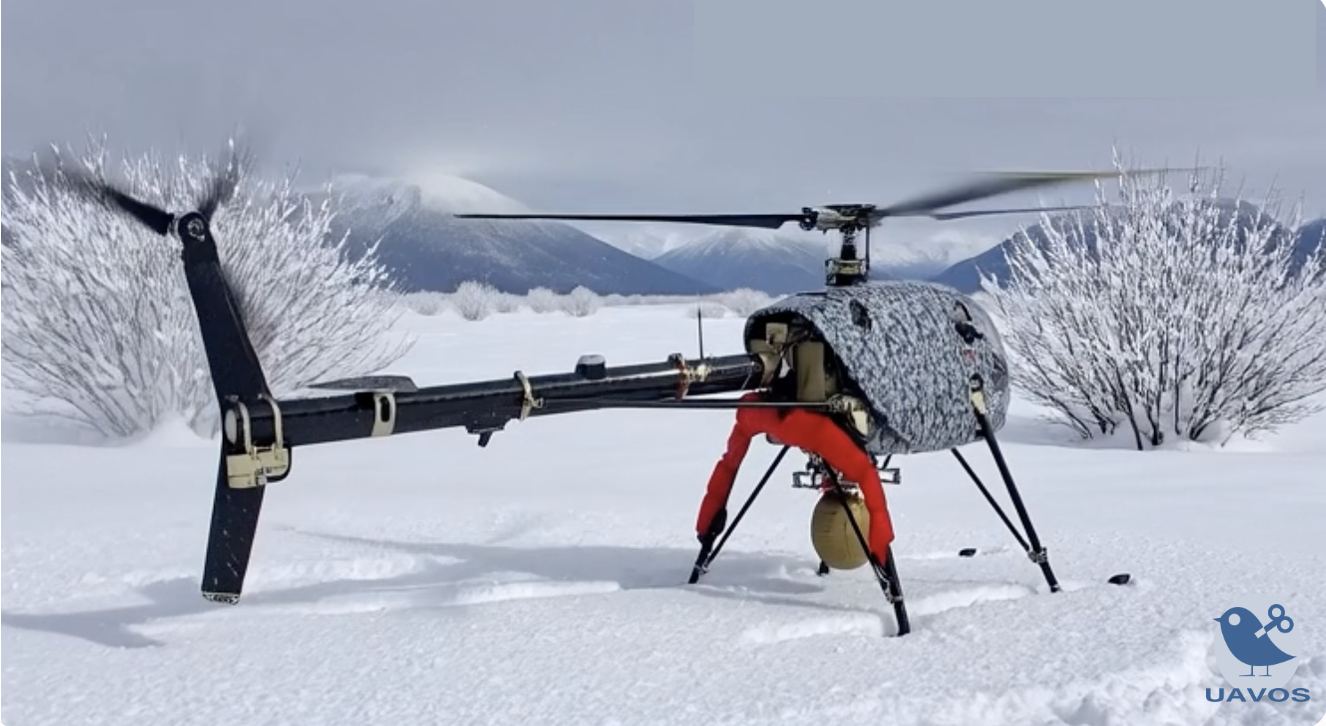
We can share UAVOS’ experience operating the UVH-170 gasoline-powered unmanned helicopter (MTOW 45 kg) in cold weather conditions:no operational issues have been observed at temperatures down to -50°C.
However, it is important that the UAV is stored at a positive temperature prior to deployment.
Pre-flight activities become significantly more difficult at temperatures of -30 to -40°C; therefore, our pilots perform flight preparation procedures inside a support vehicle.
There are no flight restrictions at temperatures of -50°C. However, restrictions apply when operating at temperatures close to 0°C in the presence of low clouds due to the risk of icing. Icing can typically be avoided by flying below the cloud layer. At the same time, the UAV should be equipped with a Pitot tube and an appropriate heating system. All onboard equipment must be industrial-grade; otherwise, its performance under such conditions may be unpredictable.
Regarding icing protection, anti-icing systems are typically not used on rotor blades of unmanned helicopters with an MTOW of up to 50 kg. The additional weight, size, and cost of anti-icing systems or heated blades are relatively high and generally not cost-effective for this class of UAV. This is why icing protection systems for this category are not widely available on the market.
Various anti-icing solutions do exist; however, they are effective only for a limited duration, typically around 30 minutes.
For example, loitering munitions typically have short operational lifespans, often limited to several minutes. In contrast, UAVs designed for monitoring or inspection missions are capable of long-endurance flights; however, they require clear weather conditions to capture high-resolution imagery.
There are also UAVs specifically developed for Arctic operations. It should be noted that airframe icing typically does not occur at temperatures below approximately -8 to -10°C, as supercooled liquid water is generally not present at these lower temperatures.
Additionally, MALE (Medium Altitude Long Endurance) UAS are usually equipped with anti-icing systems, enabling operation in a wider range of atmospheric conditions.
We can share UAVOS’ experience operating the UVH-170 gasoline-powered unmanned helicopter (MTOW 45 kg) in cold weather conditions:no operational issues have been observed at temperatures down to -50°C.
However, it is important that the UAV is stored at a positive temperature prior to deployment.
Pre-flight activities become significantly more difficult at temperatures of -30 to -40°C; therefore, our pilots perform flight preparation procedures inside a support vehicle.
There are no flight restrictions at temperatures of -50°C. However, restrictions apply when operating at temperatures close to 0°C in the presence of low clouds due to the risk of icing. Icing can typically be avoided by flying below the cloud layer. At the same time, the UAV should be equipped with a Pitot tube and an appropriate heating system. All onboard equipment must be industrial-grade; otherwise, its performance under such conditions may be unpredictable.
Regarding icing protection, anti-icing systems are typically not used on rotor blades of unmanned helicopters with an MTOW of up to 50 kg. The additional weight, size, and cost of anti-icing systems or heated blades are relatively high and generally not cost-effective for this class of UAV. This is why icing protection systems for this category are not widely available on the market.
Various anti-icing solutions do exist; however, they are effective only for a limited duration, typically around 30 minutes.

Aliaksei Stratsilatau, CEO of UAVOS
February, 2026